China Will Not Invade Siberia
A historian called Sarah Paine has recently barged into my fentanyl-drip of short form content. In between subway surfers and other blissful slop, I get clips of her takes on geopolitical analysis from the Dwarkesh Patel podcast. All of her takes are unimpressive, but one I find particularly inane is the idea that China and Russia have a rivalry over Siberian land that will soon escalate into open conflict. Paine, a deep state lifer and former DoD employee, states that China will eventually demand territory in Siberia from Russia. I have heard several variations of this point made by propagandists over the years, seemingly stemming from some CIA fetish for the US’s two greatest rivals filing for divorce, and have decided that it warrants debunking.
The claim that China will take Siberia is typically justified by the following points:
China has a historical claim to the region dating to the Qing dynasty
China is has a greater population and is militarily stronger than Russia
Siberia is a resource-rich area that can feed China's large manufacturing base and supplement China's lack of natural resources
Chinese settlers are already ethnically replacing Russians in Siberia due to the area's low population and underdevelopment
Of these only the first point stands, while the other three miss key facts that thoroughly undermine them. While it is true that China has a historical tie to the very southeastern tip of Siberia, I think that this single fact is heavily outweighed by other considerations I will outline.
1. Chinese Strategy, Encirclement
To understand why a Chinese demand for Siberia would be a terrible idea, we must first understand China's strategic position in East Asia. China's fundamental strategic weakness is that it is essentially surrounded by enemy nations, failed states and deserts. This makes Russia its only somewhat-reliable ally and stable border. China borders Russia and Mongolia in the Siberian steppe to the North. To the Northeast, China borders North Korea (a loony-state and unreliable ally) alongside South Korea and Japan, two firm US allies. Immediately to the East lies China's primary adversary and goal - Taiwan, under uncertain American protection. To the South, the jungles of Vietnam (another American ally), Laos, and Burma / Myanmar (a failed state currently in civil war). To the Southwest, two nuclear powers (Pakistan and India) locked in a struggle over the subcontinent, and the only potential rival to China's continental hegemony (India). To the Northwest, more empty steppe and the deserts of Kazakhstan and the Central Asian countries.
After considering this geographic setup, the problem with the Siberia plan should immediately become obvious: picking a fight with Russia is quite literally at the bottom of the priority list. Not only does China have four reliable US allies to deal with (Japan, South Korea, Taiwan, Vietnam) and the South China Sea to contest, but two basket-case countries to wrangle (North Korea, Burma), India to watch as a potential rival, and several weaker neighbors to bully around. China is in the boxing ring with one ally, getting pummeled by a dozen opponents - why knock out the ally? A Chinese strategist suggesting the Siberia plan would get laughed out of the room. Fundamentally, China just has other more pressing problems to solve and more important borders to contest.
2. No Viable Military Option
Not only is Russia essentially China's sole reliable ally in the region, but it is by far China's strongest neighbor, even if it is weaker than China itself. Despite exhaustion from the Ukraine War, it is clear that the Russian military remains one of the best equipped and most veteran fighting forces in the world. If we are purely counting personnel, tanks, and fighter aircraft, Russia is a clear third in the world after the US and China, and even exceeds China on some metrics. Russia maintains an army of over 1.3 million men (matched only by North Korea among China's neighbors, but behind China's army of 2 million) and has consistently ranked third in national military spending after the United States and China itself. Russia maintains an airforce more numerous than China's and has more tanks than China (as of 2026). Obviously, China could likely outproduce and out-man Russia in a protracted war, but the point is that this is a tough fight to start.
There are a few other factors to consider that make a Chinese military operation in Siberia untenable. Firstly, the Ukraine war (alongside other modern wars) has demonstrated that a smaller force equipped with FPV drones can successfully hold off a larger enemy. This logic would play in Russia’s favor in a hypothetical Chinese invasion of Siberia. The Russian army now has a wealth of experience in drone warfare far exceeding China's rookie force, which would stall an invasion and result in a flood of endless clips of drone strikes on Chinese conscripts.
Secondly, Siberia is a vast open territory with essentially no infrastructure. This makes a large scale invasion by a conventional force brutally difficult to organize and resupply. If you thought that Napoleon and Hitler invading Russia from the business end was a bad idea, imagine an invasion of Russia on the Siberian end, which is far less developed. Russian Siberia is a long string of villages on an open plain surrounded by dense forest, loosely connected by a single railway (the trans-siberian railroad) and subject to brutal freezing winters and exhausting, disease-inducing summers. Therefore, the logistical challenge of this invasion would be like nothing previously seen in history.
Lastly, and very importantly, Russia is a nuclear power. Not only is it a nuclear power, but it has the world's largest nuclear arsenal and dwarfs China's capabilities in this area. Russia currently has 4,300 nukes to China's 600 (~8x the number). Russia may also be in a better position to intercept Chinese missiles in a nuclear exchange than vice versa. For example, Russia recently exported its S-400 missile defense system to China, suggesting Russian missile defense systems are more capable. All of this means that in a nuclear exchange, Russia would likely come out on top, if Nuclear Armaggedon can ever be considered to have a winner.
In summary, a Chinese invasion of Siberia would be militarily impossible. Russia has a strong conventional army that has learnt to use drones to devastating effect. The logistical hurdles of a Siberian campaign are daunting for any attacker. And if all else fails, Russia has a nuclear arsenal that can ensure its territorial integrity is respected or that mutual destruction is assured.
3. Resource Myth
Alright, well maybe China can attempt a limited incursion just into the border regions. Or maybe the pain of an invasion is worth it to secure Siberia’s vast resource wealth. No.
Firstly, there's a clear logical gap in this argument: China can already purchase all of the Siberian resources it wants if it keeps Russia on as an ally. Russia has not denied China access to any of its resources so far, and in fact, has made efforts to open up new trade corridors with Beijing in order to find an alternative market to Europe. There is no reason given by proponents of the conflict idea for why China can't just buy the stuff that it needs from Siberia without conquering it. This is not the 1200s A.D., where trading with the next village over requires a feudal war.
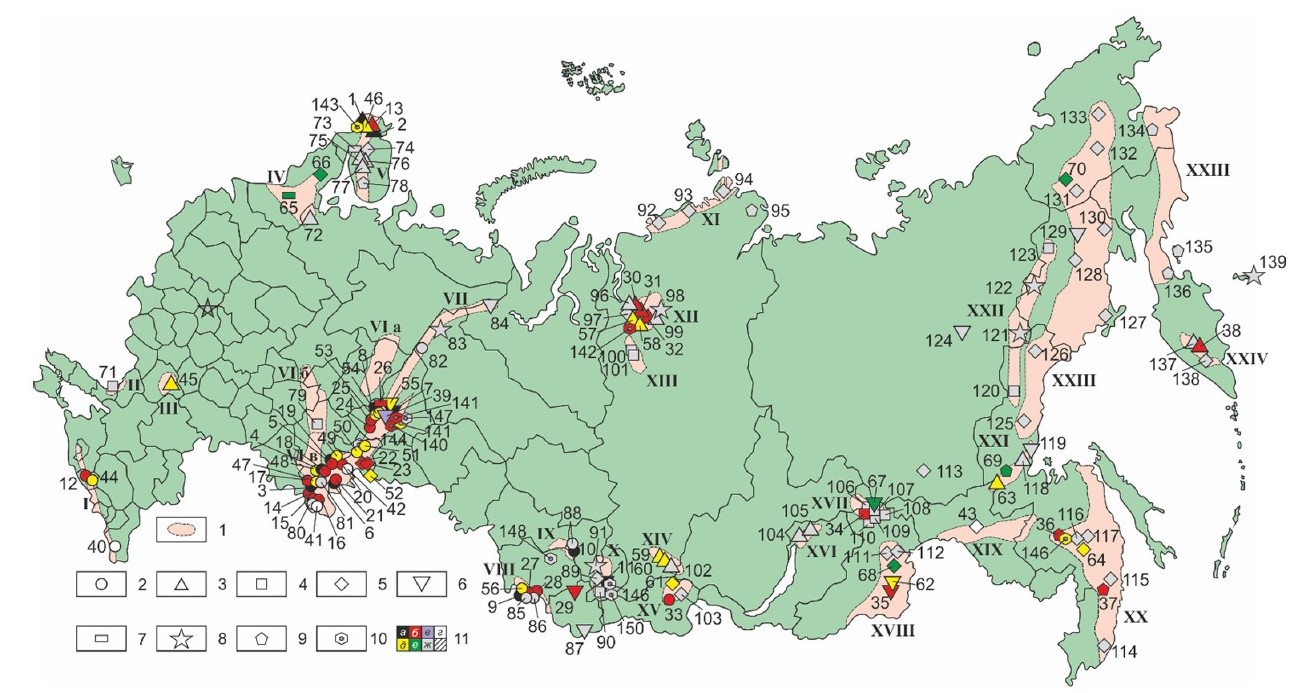
The next problem with the resource argument is that, while Siberia is quite resource-rich overall, many of its resources lie far from the border to the West or North, closer to Moscow than Beijing. Essentially, it's not quite as straightforward as China hopping over the border and seizing the mines. This is best seen on a couple of maps and charts.
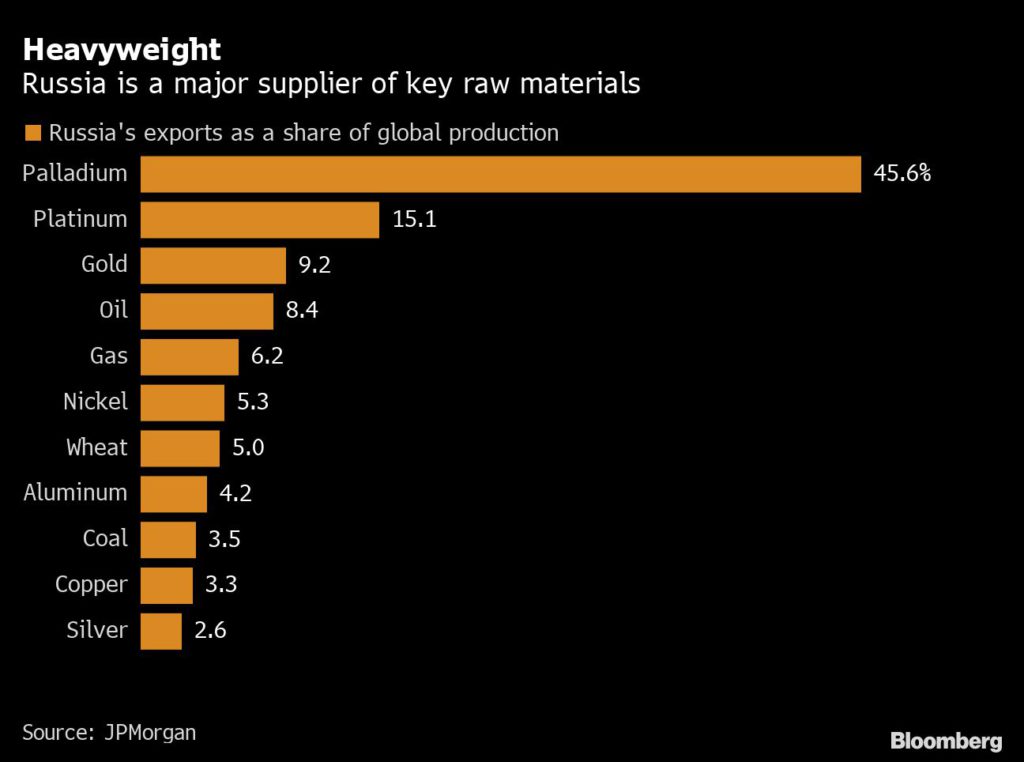
Key Russian Exports
Oil and Gas

Palladium & Nickel

Copper
Gold

Resources, Continued
Oil and gas (maybe what China seeks the most) are clustered in western Siberia just East of the Urals, with a smaller production cluster North of lake Baikal and nothing anywhere near the Chinese border. Nickel and palladium are heavily concentrated in the Kola peninsula and Norilsk area, which again is in far-Northwestern Siberia. For reference, Norilsk is about 2,800 miles in a straight line from Moscow and 3,700 miles from Beijing. Copper is clustered in the Southern Urals, with some production near the Chinese border. Gold is the only resource in the top 10 with large scale commercial production in South-East Siberia near China.
The overall picture is looking relatively bleak for China. When you dig into it (pun intended) most of the strategic resources in Siberia are generally inaccessible and thousands of miles from the Chinese border. This makes them very difficult to ship to China or to conquer, which perhaps explains why the Russia-China trade link has been relatively difficult to develop despite efforts by both countries. Recall that the Chinese historical claim only extends to border areas (the Primorye territories near Vladivostok in the far Southeast) so China would have to push far beyond its historical claim to access most of these resources. That is if they unwisely decided to conquer the territory instead of simply purchasing those resources from Russia.
4. Population Dynamics
The last factor severely handicapping China’s Siberian ambitions is the population problem. We sometimes hear of Chinese hordes ready to burst over the border and claim the region, accompanied with statistics of millions of ethnically Chinese settlers living in Russia and population maps showing drastically more people on the Chinese side of the border. While superficially true, these claims overlook a darker pattern of extremely low Chinese birth rates and the country’s general inability to settle its own interior. Consider the following map:

Note that not only are Chinese birth rates low overall, but the birth rates in China’s Northeastern provinces specifically (the region adjacent to Siberia) are the lowest in the country at 0.6-0.8 and some of the lowest of any region anywhere. As a comparison, the countries with the lowest overall birth rates in 2024 were: South Korea (0.75), Singapore (0.97), Ukraine (0.99), and China (1.01). If Northeast China were an independent country, it would likely have the single lowest birthrate in the world. For context, a birth rate of ~2.1 children per woman is typically regarded as the replacement level required for a flat population. A median birthrate of 0.7 mathematically implies that the population declines by ~65% each generation absent immigration. Therefore we see a clear problem with the Siberia plan - China is rapidly losing population in its own Northeastern provinces, much less having an excess of people to throw over the border.
Another dimension to consider is that China’s few remaining young men, like in most other countries, are softer than in prior times. China is now a developed society, and the youngest generation of Chinese men have grown up in comfortable apartments in tier-one cities watching attractive women eat ramen on BilliBilli. They might have their mind set on crypto gambling, finding a mistress, or maybe buying a fancy phone or a fancy car. This is the very same generation that invented “lying flat”, or avoiding social obligations through inaction. Is this really a society that can motivate its young men to go out into the wild forests of Siberia and carve out a homestead? Siberia is not a land that gives freely without requiring a lifetime of hard work in exchange, which doesn’t suit the fancy of modern man in all his comforts.
One can point out that this criticism is just the eternal nagging of the old man at the young man about “how much harder things were back then”. But I think it holds some objective merit given that we’ve seen almost every developed society in the 21st century struggle to motivate young men to do difficult things like join the army (or leave their basement), which is evidenced in army recruitment statistics and other empirical data. On similar grounds, China would probably face an immediate shortage of willing colonists for Siberia, both due to an overall lack of young men and their complacency with a more modern lifestyle, incompatible with homesteading a hostile land.
Conclusion
In summary, there is not a snowball’s chance in hell that China annexes Siberia. This idea is strategically nonsensical, militarily impossible, provides no tangible benefit to China, and overlooks China’s demographic difficulties. I encourage our spooks to put more effort into their strategic analysis, so that these delusions of a split among America’s enemies don’t imbue them with false hope. And who knows, if they finally retire Sarah Paine, maybe my algorithm will go back to soothing videos of a man gently pressing his fist onto colorful blocks of sand and similarly engaging content.
Back to all essays